

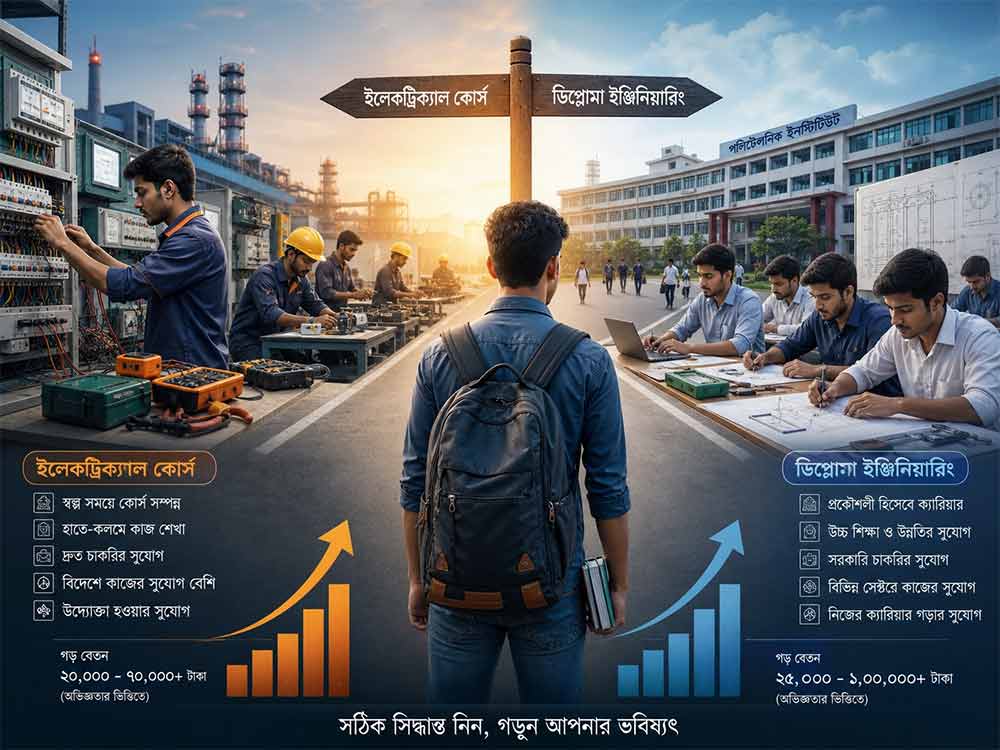
Electrical Course vs Diploma in Bangladesh: Which is Better for Your Career
Electrical Course vs Diploma in Bangladesh: Which is Better for Your Career?
Bangladesh is going through a rapid phase of industrial and infrastructural development. From garment factories to high-rise buildings, from smart homes to massive power plants — skilled electrical professionals are needed everywhere. If you are thinking about building a career in the electrical field, you might be facing one big question: Should I do a short electrical course or pursue a full electrical engineering diploma?
This article will help you understand the key differences between an electrical course and an electrical diploma in Bangladesh, compare their costs, career outcomes, job opportunities, and ultimately help you decide which path is right for you.
What is an Electrical Course?
An electrical course is a short-term, skill-based training program designed to teach practical electrical skills in a short time. These courses are typically offered by private training institutes, technical training centers, and vocational institutes across Bangladesh.
At New Hope Training Center in Dhaka, for example, students can enroll in professional electrical courses covering house wiring, industrial wiring, VFD and motor control, AC and refrigeration servicing, PLC automation, and CCTV installation — all with hands-on lab training and recognized certificates.
Common Electrical Courses Available in Bangladesh:
- House Wiring Course (1–3 months)
- Industrial Wiring Course (1–3 months)
- Advance Motor Controlling Course
- AC and Refrigerator (RAC) Servicing Course
- PLC (Programmable Logic Controller) Course
- CCTV Installation Course
- Electrical Installation & Maintenance Course (2–3 months)
Key Features of an Electrical Course:
- Duration: 1 to 6 months
- Fees: BDT 8,000 to BDT 20,000 (affordable for most families)
- Entry Requirement: Class 8 pass or SSC pass
- Focus: 80–90% practical, hands-on training
- Certificate: Industry-recognized or government-recognized certificate
- Job Entry: You can start working within weeks of course completion
What is an Electrical Diploma?
An electrical diploma, officially called the Diploma in Electrical Engineering, is a 4-year technical education program offered by polytechnic institutes and technical colleges under the Bangladesh Technical Education Board (BTEB). It is a formal academic qualification that combines both theoretical knowledge and practical training.
Key Features of an Electrical Diploma:
- Duration: 4 years (some institutions offer 2-year programs)
- Fees: BDT 50,000 to BDT 2,00,000 or more (total over the program)
- Entry Requirement: SSC pass with a Science or Technical background
- Focus: 50–60% theory, 40–50% practical lab
- Certificate: BTEB recognized diploma certificate
- Job Entry: After 4 years, competitive with degree holders in some sectors
Electrical Course vs Diploma: Side-by-Side Comparison
The table below summarizes the most important differences between an electrical short course and a full diploma program in Bangladesh:
| Feature | Electrical Course (Short) | Electrical Diploma (Long) |
| Duration | 1–6 Months | 2–4 Years |
| Cost | BDT 8,000–20,000 | BDT 50,000–2,00,000+ |
| Focus | Practical Skills | Theory + Practice |
| Entry Requirement | Class 8 / SSC Pass | SSC Pass (Science/Tech) |
| Job Entry Speed | Very Fast | Slow (after completion) |
| Salary (Entry) | BDT 15,000–30,000 | BDT 20,000–40,000 |
| Abroad Opportunity | High (Gulf, Malaysia) | Moderate |
| Entrepreneurship | Easy to Start Own Work | Moderate |
| Certificate | Industry / Govt Recognized | Board Recognized |
| Best For | Quick earners, job seekers | Engineers, management roles |
Career Opportunities After an Electrical Course in Bangladesh
One of the biggest advantages of completing a practical electrical course is the speed at which you can enter the job market. Within 1 to 3 months, you gain skills that are directly applicable in real-world settings.
Local Job Opportunities:
- Residential and commercial electrician
- Factory electrician in the garment, textile, and manufacturing industries
- Electrical maintenance technician in hotels, hospitals, and offices
- AC and refrigerator technician
- CCTV and security system installer
- PLC and automation technician (after advanced courses)
- Self-employed electrical contractor
International Job Opportunities:
Bangladesh has a strong overseas job market for skilled electricians, especially in the Gulf countries (Saudi Arabia, UAE, Qatar, Kuwait, Oman, Bahrain) and Southeast Asia (Malaysia, Singapore). Skilled electricians with practical certificates can earn BDT 40,000 to BDT 1,00,000+ per month abroad.
- Saudi Arabia – High demand for building and industrial electricians
- UAE and Qatar – Construction boom requires skilled technicians
- Malaysia – Garment and manufacturing sector jobs
- Singapore – High-end electrical installation and maintenance
Salary Expectations After an Electrical Course:
- Entry Level: BDT 12,000 – 18,000/month
- Mid Level (2–3 years experience): BDT 20,000 – 35,000/month
- Senior Technician: BDT 35,000 – 60,000/month
- Self-employed contractor: BDT 50,000 – 1,50,000+/month
Career Opportunities After an Electrical Diploma in Bangladesh
A diploma in electrical engineering opens doors to slightly different, and in some cases, higher-level positions. Diploma holders are often considered for supervisory or junior engineering roles in larger organizations.
Job Roles for Diploma Holders:
- Junior Electrical Engineer
- Sub-Assistant Engineer (government sector jobs, BREB, DESCO, PGCB, REB)
- Electrical Supervisor in construction companies
- Technical Officer in banks and telecom companies
- Instructor in technical training institutes
- Further study: B.Sc. Engineering (with credit transfer or direct admission)
Salary Expectations After Electrical Diploma:
- Entry Level: BDT 18,000 – 30,000/month
- Mid Level: BDT 30,000 – 55,000/month
- Government Sub-Assistant Engineer: BDT 25,000 – 50,000/month (plus benefits)
- Private sector engineer: BDT 40,000 – 80,000/month
Which is Better: an electrical course or a diploma for a career in Bangladesh?
The answer depends on your personal goals, financial situation, time availability, and long-term ambitions. Here is a practical breakdown to help you decide:
Choose an Electrical Course if:
- You need to start earning money quickly (within 3–6 months)
- You have a limited budget and cannot afford 4 years of education
- You want practical skills to work as a technician or electrician
- You are planning to work abroad (Gulf countries, Malaysia)
- You want to start your own electrical business or contracting work
- You are already working and want to upgrade your skills
- You passed Class 8 or SSC and want a direct career path
Choose an Electrical Diploma if:
- You want to qualify for government jobs (BREB, DESCO, REB, PGCB, etc.)
- You aspire to become a junior or assistant engineer in a large company
- You plan to continue studying for a B.Sc. in Electrical Engineering
- You have time and financial support for a 4-year program
- You are interested in the theoretical and design aspects of electrical engineering
- You want to work in managerial or supervisory roles in the future
Can You Do Both? A Smart Career Strategy
Many successful electrical professionals in Bangladesh use a combined approach: first they complete a short practical electrical course to start earning quickly, and then later pursue a diploma or degree while working. This strategy gives you the best of both worlds — early income and long-term career growth.
For example, a student from Dhaka can enroll in a 3-month electrical house wiring and industrial course at New Hope Training Center, get a job as a factory electrician, and then pursue a part-time diploma later. This is both financially smart and career-focused.
Why Practical Electrical Training is More Valuable in Today’s Bangladesh
Bangladesh’s job market increasingly values practical, hands-on skills over academic qualifications alone. Employers in the garment sector, construction industry, real estate, and manufacturing prefer technicians who can work on the job from day one.
Government-led initiatives like the National Skills Development Authority (NSDA), the Skills for Employment Investment Program (SEIP), and the Technical and Vocational Education and Training (TVET) policy all emphasize vocational and practical training as key to reducing youth unemployment in Bangladesh.
Short electrical courses that provide verified certificates, hands-on experience, and job placement support are increasingly recognized as valid credentials by both local and international employers.
About New Hope Training Center – Best Electrical Course in Dhaka
New Hope Training Center is a modern, professional electrical training institute located at Dakkhin Khan Bazar, Dhaka Airport Area, Dhaka-1230. Established in 2025, the center is dedicated to empowering young Bangladeshis with practical, job-ready electrical skills.
What New Hope Training Center Offers:
- Professional House Wiring Course – BDT 8,000 (1–3 months)
- Professional Industrial Wiring Course – BDT 10,000 (1–3 months)
- Electrical Installation & Maintenance – BDT 15,000 (2–3 months)
- Refrigeration and AC (RAC) Course – BDT 12,000 (1–3 months)
- Advance Motor Controlling Course
- PLC (Programmable Logic Controller) Course
- CCTV Camera Installation Course
Why Choose New Hope Training Center?
- 100% practical, hands-on training with real electrical tools and setups
- Expert and certified trainers with years of field experience
- Industry-recognized certificates verifiable online
- Small batch sizes (12 students per batch) for personalized attention
- Job placement support and career counseling
- Affordable fees with maximum value
- Located near Dhaka Airport – easily accessible from all areas of Dhaka
Whether you are a student, a job seeker, or someone looking to upgrade skills, New Hope Training Center provides the training you need to build a successful electrical career in Bangladesh and beyond.
Frequently Asked Questions (FAQs)
Q1: Is an electrical course certificate valid for jobs in Bangladesh?
Yes. Certificates from recognized training institutes like New Hope Training Center are accepted by employers in Bangladesh and internationally. The certificates can also be verified online, making them credible for job applications abroad.
Q2: How much can an electrician earn in Bangladesh after a short course?
An electrician can earn between BDT 12,000 and BDT 35,000 per month in Bangladesh. With experience and advanced skills such as PLC or industrial automation, salaries can go much higher. Electricians working abroad can earn BDT 50,000 to BDT 1,00,000 or more per month.
Q3: Can I do an electrical course without SSC?
Yes. Most practical electrical courses in Bangladesh, including those at New Hope Training Center, accept students who have passed Class 8 or equivalent. You do not need an SSC certificate to enroll in a short course.
Q4: Is a diploma necessary to become an electrician?
No. A diploma is required for engineering or supervisory roles, but it is not necessary to become a skilled electrician. Practical training certificates are sufficient for field electrician positions in Bangladesh and abroad.
Q5: What is the best electrical course in Dhaka?
New Hope Training Center in Dhaka Airport Area offers some of the best practical electrical courses in Dhaka, including house wiring, industrial wiring, AC and RAC servicing, PLC, and advanced motor controlling. The courses are affordable, hands-on, and come with verified certificates.
Q6: Which is better for getting a job abroad – a course or a diploma?
For working abroad (especially in Gulf countries and Malaysia), a practical electrical course certificate is often sufficient. Employers abroad value proven skills and hands-on competency over academic degrees. However, an electrical diploma can add value for supervisory roles in international companies.
Both electrical courses and diplomas have their own value in Bangladesh’s job market. The choice between them should be based on your personal circumstances, goals, and resources.
If you want to start your career quickly, earn money within months, or work abroad, a practical electrical course from a reputable training center like New Hope Training Center in Dhaka is the smarter and faster path. The investment is low, the training is hands-on, and the certificates are recognized both locally and internationally.
If you have long-term goals of working in government-sector engineering positions or pursuing higher education in electrical engineering, a diploma is worth the time and investment.
The best move? Start with a short electrical course, build practical experience, and then continue your education. This is how thousands of skilled Bangladeshi electricians are building successful, well-paying careers today.