

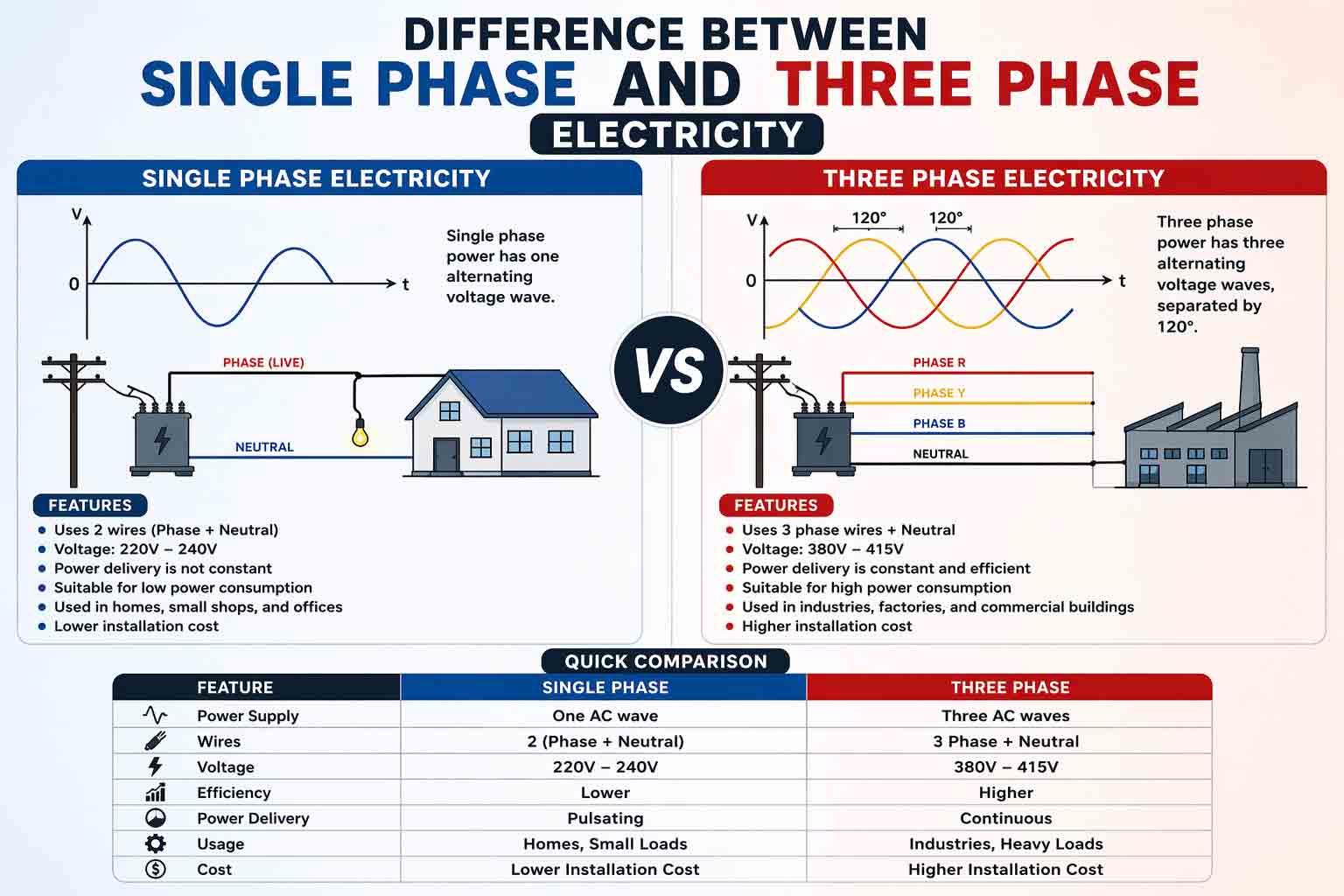
Difference Between Single Phase and Three Phase Electricity
Difference Between Single Phase and Three Phase Electricity – Complete Guide (2026)
Learn the difference between single phase and three phase electricity with examples, advantages, disadvantages, and applications in this complete guide.
Electricity is a fundamental part of modern life, powering everything from household appliances to large industrial machines. One of the most important concepts in electrical systems is understanding the difference between single phase and three phase electricity.
Both types of power supply are widely used, but they serve different purposes depending on the load, efficiency, and application. In this article, we will explore what single phase and three phase electricity are, how they work, and their key differences in a simple and practical way.
What is Single Phase Electricity?
Single phase electricity is the most common type of power supply used in homes and small businesses. It consists of one alternating voltage waveform.
Key Characteristics:
- Uses two wires: one phase (live) and one neutral
- Voltage is usually 220V–240V (in many countries)
- Power delivery is not constant
- Suitable for low power consumption
How It Works:
In a single phase system, electricity flows through one sinusoidal wave. This means the power supply rises and falls, causing slight fluctuations in power.
Common Uses:
- Home appliances (fans, lights, TVs)
- Small shops and offices
- Low-power devices
What is Three Phase Electricity?
Three phase electricity is mainly used in industrial and commercial settings. It uses three alternating currents that are out of phase with each other by 120 degrees.
Key Characteristics:
- Uses three phase wires + one neutral
- Provides continuous and stable power
- Voltage can be 380V–415V
- More efficient for heavy loads
How It Works:
In a three phase system, three waves are generated with a phase difference of 120°. This ensures that power is delivered continuously without interruption.
Common Uses:
- Industrial machines
- Large motors and pumps
- Factories and commercial buildings
Difference Between Single Phase and Three Phase Electricity (Comparison Table)
| Feature | Single Phase | Three Phase |
|---|---|---|
| Power Supply | One AC wave | Three AC waves |
| Wires | 2 (Phase + Neutral) | 3 Phase + Neutral |
| Voltage | 220–240V | 380–415V |
| Efficiency | Lower | Higher |
| Power Delivery | Pulsating | Continuous |
| Cost | Lower installation cost | Higher installation cost |
| Usage | Homes, small loads | Industries, heavy loads |
| Motor Efficiency | Low | High |
Advantages of Single Phase Electricity
- Simple and easy to install
- Low installation cost
- Suitable for residential use
- Requires less maintenance
Advantages of Three Phase Electricity
- Provides constant power supply
- More efficient for heavy loads
- Supports large motors
- Reduces energy loss
Disadvantages of Single Phase Electricity
- Not suitable for heavy machinery
- Power fluctuations can occur
- Less efficient
Disadvantages of Three Phase Electricity
- Higher installation cost
- Complex system
- Not necessary for small homes
Applications of Single Phase Electricity
Single phase electricity is ideal for everyday household use. It is commonly used in:
- Residential homes
- Small businesses
- Lighting systems
- Small electrical appliances
Applications of Three Phase Electricity
Three phase electricity is essential for high power requirements:
- Industrial plants
- Manufacturing factories
- Heavy-duty motors
- HVAC systems
Which is Better: Single Phase or Three Phase?
The answer depends on your needs:
- For homes and small loads → Single Phase is better
- For industries and heavy equipment → Three Phase is better
Three phase systems are more efficient and powerful, but they are not necessary for small-scale usage.
Future of Electrical Power Systems
With the growth of industrialization and renewable energy, three phase systems are becoming more important. However, single phase electricity will continue to dominate residential areas.
Modern systems often combine both types to ensure efficiency and flexibility.
Understanding the difference between single phase and three phase electricity is essential for anyone working with electrical systems.
Single phase electricity is perfect for homes and small applications, while three phase electricity is designed for industrial use and heavy loads. Both systems have their advantages and play an important role in modern electrical infrastructure.
By choosing the right type of power supply, you can ensure safety, efficiency, and long-term performance of your electrical system.